There are few things more unsettling than feeling your heart behave strangely. A flutter in your chest, a sudden racing pulse that comes out of nowhere, a skipped beat that catches you off guard — these sensations are alarming precisely because the heart is not something you can afford to ignore. And yet many people sit with these symptoms for weeks or months, unsure whether what they are feeling is serious or simply anxiety. That uncertainty takes a toll. It interrupts sleep, creates dread during physical activity, and produces a constant background worry that makes daily life harder than it needs to be. When your heart feels unpredictable, everything else feels uncertain too.
The frustration deepens when people begin searching for answers and encounter a maze of cardiac tests they have never heard of. Holter monitors, EKGs, stress tests, echocardiograms — the terminology alone can feel overwhelming. Most patients simply want to know: what is causing this, is it dangerous, and what can be done about it? Two of the most commonly ordered cardiac tests — the EKG and the Holter monitor — are often confused with each other, but they serve very different purposes. Understanding the difference between them helps you ask the right questions and get the right answers faster.
At Express Internal Medicine in Plano, TX, Dr. Iram Qureshi provides in-office EKG testing and comprehensive cardiac evaluation for patients experiencing heart rhythm concerns. Our goal is to give you a clear, accurate picture of your heart health quickly — without unnecessary delays or referrals that slow down answers. Whether you need a baseline EKG or a more extended cardiac monitoring plan, we are equipped to guide you through every step.
What Is an EKG and How Does It Work?
An electrocardiogram — commonly called an EKG or ECG — is a test that records the electrical activity of your heart at a specific moment in time. It is one of the most widely used diagnostic tools in medicine and is typically performed in under 10 minutes in a clinical setting.
During an EKG, small adhesive electrodes are placed on your chest, arms, and legs. These electrodes detect the electrical impulses that travel through your heart muscle with each beat and transmit that data to a machine that produces a printed or digital graph. The resulting waveform allows your physician to assess your heart rate, heart rhythm, the strength and timing of electrical signals, and the overall condition of the heart muscle.
An EKG is an excellent tool for capturing what is happening in your heart at the exact moment of the test. It can detect a current heart attack, prior heart attack damage, arrhythmias that are actively present, enlarged heart chambers, and conduction abnormalities. It is fast, non-invasive, painless, and provides immediate results — making it an ideal first-line cardiac test.
What Is a Holter Monitor and How Is It Different?
A Holter monitor is a small, portable device that records your heart’s electrical activity continuously over an extended period — typically 24 to 48 hours, though some monitors record for 7 to 14 days or longer. Like an EKG, it uses electrodes attached to your chest connected to a recording device you wear throughout your daily activities.
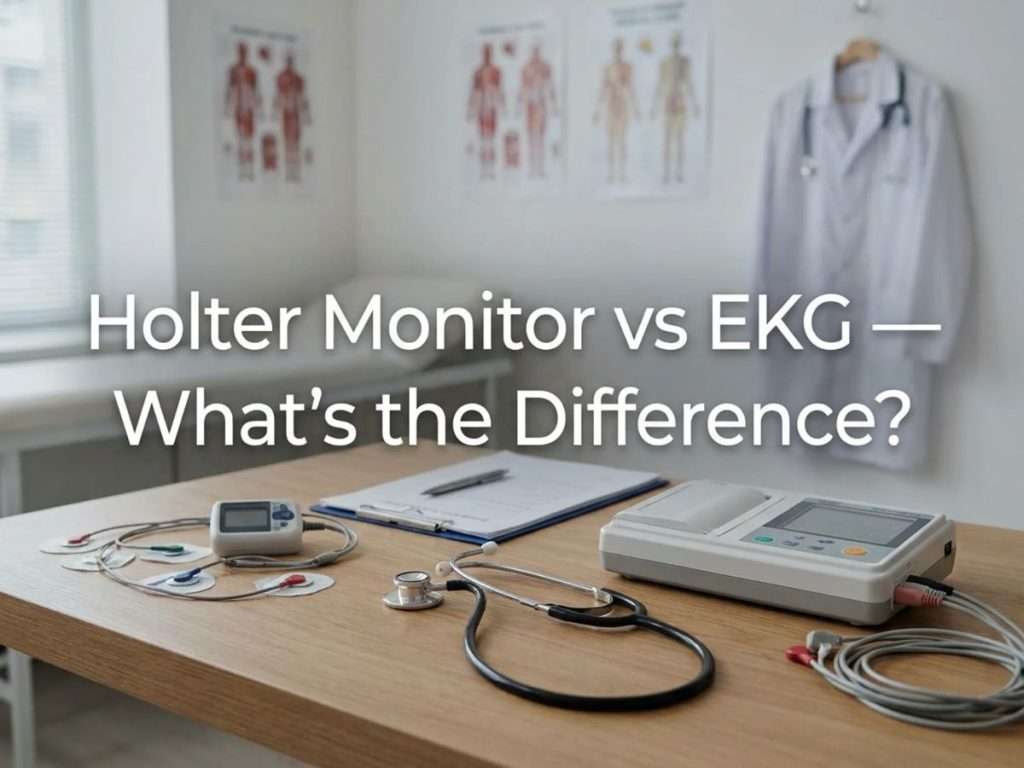
The fundamental difference between a Holter monitor and an EKG comes down to duration and context. An EKG is a snapshot — a 10 to 15 second recording of your heart in a controlled clinical setting. A Holter monitor is a full-length video — capturing your heart’s behavior as you sleep, exercise, feel stressed, eat, and go about your normal day. This extended recording window makes it possible to catch arrhythmias and rhythm abnormalities that may not be present during a brief office visit.
Many cardiac symptoms — palpitations, dizziness, fainting, and irregular heartbeat episodes — are intermittent. They come and go unpredictably, which means a standard EKG will often return completely normal results even in patients who genuinely have a rhythm disorder. The Holter monitor solves this problem by watching continuously long enough to catch the abnormality when it actually occurs.
EKG vs Holter Monitor — Key Differences at a Glance
Understanding exactly how these two tests compare helps clarify when each one is the appropriate choice.
Duration of recording: An EKG captures 10–15 seconds of cardiac electrical activity in a single sitting. A Holter monitor records continuously for 24 hours to 14 days or more, depending on the clinical situation and the type of monitor used.
Setting and convenience: An EKG is performed entirely in the doctor’s office and requires you to lie still for a few minutes. A Holter monitor is worn throughout your normal daily life — you go home, go to work, sleep, and exercise while wearing it, then return the device to your provider for analysis.
What each test detects: An EKG detects active arrhythmias, heart attack changes (current or past), conduction delays, and structural electrical abnormalities present at the time of testing. A Holter monitor detects intermittent arrhythmias, patterns in heart rate variability, rhythm changes during specific activities or times of day, and correlations between symptoms and electrical events.
Patient symptom diary: During Holter monitoring, patients are asked to keep a log of their symptoms — noting the exact time they feel palpitations, dizziness, or chest tightness. This diary is correlated with the recorded data to determine whether symptoms correspond to actual electrical abnormalities or occur during normal rhythm periods.
Speed of results: EKG results are available immediately during your office visit. Holter monitor results require analysis of the full recording period, typically returning within a few days of the monitor being returned.
Cost and accessibility: EKGs are among the most affordable and widely available cardiac tests. Holter monitoring involves the cost of the device rental and technical analysis of the recording, making it somewhat more involved — but still far less expensive than advanced imaging or specialist-only procedures.
When Would a Doctor Order an EKG?
An EKG is typically the first cardiac test ordered and is appropriate in a wide range of clinical situations. Your primary care physician may recommend an EKG test when you present with chest pain, shortness of breath, palpitations, dizziness, or fainting — to immediately rule out active heart attack, severe arrhythmia, or conduction abnormalities that require urgent intervention.
EKGs are also used routinely as part of annual physical exams for patients over a certain age or with risk factors such as high blood pressure, diabetes, high cholesterol, or a family history of heart disease. They are performed before surgery as part of preoperative medical clearance, and they serve as a baseline recording against which future EKGs can be compared if symptoms develop later.
An EKG is also the right starting point when a patient has a known condition — such as atrial fibrillation, heart block, or a previous heart attack — and comes in for a routine check or reports new or changing symptoms.
When Would a Doctor Order a Holter Monitor?
A Holter monitor becomes the appropriate next step when a patient’s symptoms are intermittent and an EKG has returned normal or inconclusive results. The core clinical question a Holter monitor answers is: what is your heart doing when you are not in the office?
Unexplained palpitations: If you frequently feel your heart fluttering, racing, or skipping but your in-office EKG is normal, a Holter monitor provides the extended observation window needed to catch the episode as it actually occurs.
Episodes of dizziness or near-fainting: Transient drops in heart rate or brief episodes of abnormal rhythm can cause lightheadedness and near-syncope without warning. A Holter monitor can identify whether a rhythm abnormality is responsible or whether the cause lies elsewhere.
Evaluating known arrhythmia treatment: If a patient is already on medication or has had a cardiac procedure for an arrhythmia, a Holter monitor is used to confirm that the treatment is working and that the arrhythmia is adequately controlled throughout the day and night.
Assessing rate control in atrial fibrillation: For patients with atrial fibrillation, a Holter monitor tracks whether the heart rate is consistently controlled across varied activity levels — at rest, during exertion, and during sleep — providing a complete picture of treatment effectiveness.
Evaluating heart rate variability: Changes in the variation of time between heartbeats can be an early marker of autonomic nervous system dysfunction, which can be assessed through extended Holter recording in appropriate clinical contexts.
Other Cardiac Monitoring Options Beyond the Standard Holter
For patients whose symptoms are infrequent — occurring less than once every 24–48 hours — a standard Holter monitor may not capture an event during the recording window. In these cases, extended or event-based monitoring options are available.
Extended Holter monitors can record for 7 to 14 days, increasing the likelihood of capturing an intermittent arrhythmia. Event monitors are patient-activated devices worn for up to 30 days — patients press a button when symptoms occur, triggering a recording of the surrounding cardiac activity. Implantable loop recorders are small devices placed under the skin for up to three years in patients with very infrequent but high-risk symptoms such as unexplained fainting.
Your primary care physician can evaluate your symptom pattern and frequency to recommend the most appropriate monitoring duration and type. Understanding the difference between an EKG and a stress test is also helpful, as exercise stress testing adds another dimension — observing cardiac electrical activity during physical exertion rather than at rest.
How Does Heart Rhythm Monitoring Connect to Chronic Disease?
Heart rhythm abnormalities rarely exist in isolation. They are often linked to underlying conditions that a primary care physician is uniquely positioned to evaluate and manage together.
High blood pressure is one of the most significant contributors to structural heart changes that predispose patients to arrhythmias. Patients managing hypertension and heart disease are at elevated risk for atrial fibrillation and benefit from periodic cardiac monitoring as part of their ongoing care.
Diabetes and insulin resistance can damage the autonomic nerves that regulate heart rate, producing a condition called cardiac autonomic neuropathy. Patients with diabetes management needs may require EKG monitoring more regularly as part of their long-term complication screening.
Thyroid disorders — both hypothyroidism and hyperthyroidism — directly affect heart rate and rhythm. Hyperthyroidism in particular can cause rapid or irregular heartbeats that mimic primary arrhythmias. Evaluating thyroid function is a routine part of any cardiac symptom workup.
Sleep apnea causes repetitive drops in oxygen during the night that stress the heart and are strongly associated with atrial fibrillation and other rhythm disorders. Addressing sleep apnea is often an important component of managing persistent cardiac arrhythmias.
Getting a Heart Rhythm Test Near You
If you have been experiencing palpitations, irregular heartbeat, unexplained dizziness, or chest discomfort, you do not need to wait for a specialist referral to begin your evaluation. A primary care physician can order an EKG in the office during your visit, interpret the results immediately, and determine whether extended Holter monitoring or further cardiac workup is the appropriate next step.
At Express Internal Medicine, our EKG testing services are available for both acute concerns and routine cardiac screening. We also coordinate all necessary follow-up monitoring and specialist collaboration to ensure you get a complete, accurate answer — not just a single data point. If you need a same-day appointment for new or concerning cardiac symptoms, we are here to see you promptly.
Conclusion
An EKG and a Holter monitor both measure your heart’s electrical activity — but they answer fundamentally different questions. An EKG tells your doctor what your heart is doing right now, in the office, during a brief recording. A Holter monitor tells your doctor what your heart is doing throughout your real life — during stress, sleep, exercise, and everything in between. Most patients begin with an EKG, and those with intermittent symptoms move on to Holter monitoring when the EKG alone does not provide enough information. Together, these tools give physicians a comprehensive view of cardiac rhythm health that neither test can provide alone. If you have been wondering about your heart, the best step you can take is to stop wondering and start finding out.
Frequently Asked Questions
1. What is the main difference between a Holter monitor and an EKG? An EKG records your heart’s electrical activity for 10–15 seconds in a clinic. A Holter monitor records continuously for 24 hours to several weeks while you go about your daily life, making it ideal for catching intermittent rhythm problems.
2. Do I need a referral to get an EKG or Holter monitor? No referral is needed to see a primary care physician for cardiac symptoms. Your primary care doctor can order and interpret an EKG in the office and arrange Holter monitoring directly, without requiring a specialist visit first.
3. Can an EKG detect an irregular heartbeat? Yes — if the irregular heartbeat is present at the time of the test. If the arrhythmia comes and goes, the EKG may return normal even when you genuinely have a rhythm disorder, which is why Holter monitoring is used for intermittent symptoms.
4. Is a Holter monitor uncomfortable to wear? Most patients find Holter monitoring quite manageable. The electrodes and lead wires are lightweight and the recording device is small enough to clip to a belt or waistband. You continue all normal activities except swimming or bathing with the device on.
5. How long does Holter monitor analysis take? After you return the device, the full recording is analyzed — typically within 2–5 business days. Your physician will review the findings with you at a follow-up appointment or communicate results as soon as they are available.
6. What heart conditions can a Holter monitor detect? Holter monitors are used to detect atrial fibrillation, supraventricular tachycardia, ventricular arrhythmias, bradycardia, heart block, and correlations between symptoms and electrical rhythm events throughout the recording period.
7. How much does an EKG cost? EKG costs vary by location and insurance coverage. At many primary care offices, an EKG performed as part of a visit is covered by most insurance plans. It is one of the most affordable cardiac tests available, far less expensive than imaging studies or specialist procedures.
8. Can anxiety cause abnormal EKG results? Anxiety can cause a faster-than-normal heart rate (sinus tachycardia) that appears on an EKG, but it does not typically cause true arrhythmias. If anxiety-driven symptoms are frequent, a Holter monitor can help confirm whether the episodes involve genuine rhythm abnormalities or a normal rapid response to stress.
9. What should I do if my EKG is normal but I still have palpitations? A normal EKG with ongoing palpitation symptoms is a common scenario and does not mean your symptoms are not real. It typically means the arrhythmia was not present at the moment of the test. Ask your doctor about Holter monitoring or an extended event monitor to capture symptoms when they occur.
10. When are cardiac symptoms considered an emergency? Seek emergency care immediately if you experience chest pain with shortness of breath, palpitations with fainting or near-fainting, sudden severe weakness or neurological symptoms, or a rapid heart rate above 150 beats per minute that does not resolve on its own.
Disclaimer
This blog is provided for educational purposes only and does not constitute medical advice, diagnosis, or treatment recommendations.

Dr. Iram Qureshi is a dedicated board-certified Internal Medicine physician with a strong passion for preventative care and weight-loss management. With over five years of experience as a hospitalist, Dr. Qureshi has honed her expertise in treating acute medical conditions and focusing on preventing hospitalizations. She is committed to providing compassionate care and evidence-based guidance to help patients lead healthier lifestyles.
As the co-founder of Express Internal Medicine, Dr. Qureshi works alongside her husband, Dr. Adeel Khan, to create a welcoming and supportive environment for patients. She specializes in weight-loss management, offering personalized treatment plans aimed at achieving sustainable health outcomes. Dr. Qureshi holds degrees from Ohio State University and The University of Pikeville-Kentucky College of Osteopathic Medicine, with internal medicine training from Midwestern University OPTI in Sierra Vista, Arizona.
Fluent in English and Urdu/Hindi, Dr. Qureshi is passionate about educating her patients and empowering them to take charge of their health. Outside of her medical practice, she enjoys cooking, traveling, photography, and movies.